In the fight against financial crime, policies and procedures are only as strong as the people who execute them. Regulators are increasingly scrutinising not just whether a firm has a KYC programme on paper, but whether its staff can demonstrate operational understanding—what to do, when to escalate, and how decisions are documented. This is where effective KYC training moves from a box-ticking exercise to a core pillar of compliance.
Why KYC Training Is a Continuous, Role-Specific Imperative
A single missed red flag can allow illicit funds to flow through the financial system. Untrained employees are a direct risk: they may accept incomplete documentation, overlook suspicious activity, or fail to apply due diligence consistently. The consequences are not abstract—they include heavy regulatory penalties, reputational damage that erodes customer trust, and legal exposure if an institution becomes a conduit for money laundering.
Crucially, KYC training is not a one-time event. It must be a continuous process that keeps pace with evolving regulations and criminal methodologies. A 2026 guide on KYC AML training emphasises that content must be role-specific: front-line staff, compliance officers, and the Board each require different training tailored to their responsibilities. Senior management sets the tone from the top, and the Board of Directors is accountable for overseeing the entire programme and ensuring adequate resources are allocated.
What Effective KYC Training Looks Like in 2026
The most effective training programmes share several characteristics. They are practical and scenario-based, moving beyond definitions to simulate the real workflows analysts encounter—customer onboarding, sanctions screening, transaction monitoring alerts, and enhanced due diligence investigations. The AML Incubator’s 2026 training series, for example, includes modules on KYC/CDD operations covering identity verification, red flags, and documentation discipline, with knowledge checks and completion records that can support audit and partner due diligence requests.
Training should also be audit-ready. Regulators and banking partners increasingly expect evidence that training is effective beyond attendance logs—they want to see proof of operational competence and consistent escalation discipline. A multi-layered communication strategy reinforces this, using policies, SOPs, circulars, FAQs, and focus alerts to keep staff continuously informed of regulatory updates.
The Regulatory Backdrop: A Moving Target
The regulatory framework itself demands this level of rigour. In India, the Reserve Bank of India’s KYC Master Directions, updated as recently as September 2026, impose detailed customer identification and monitoring obligations on regulated entities. The Prevention of Money-Laundering Act, 2002, and the PML Rules, 2005, provide the legal foundation, while FATF recommendations set the international standard. For professionals, keeping pace with these changes is a career-long requirement—and for employers, ensuring their teams are trained on the latest requirements is a regulatory expectation, not an option.
Practical Best Practices for Building a Robust Training Programme
Based on current guidance, organisations should consider the following:
- Make it continuous, not annual. Schedule regular refresher sessions and knowledge-sharing between onboarding officers, particularly for complex cases.
- Tailor content by role. Front-line staff need practical red-flag recognition; compliance officers need deeper investigative and reporting skills; the Board needs governance and oversight-focused content.
- Use real-world case studies. Training that simulates actual AML/KYC investigations—customer onboarding, sanctions screening, EDD probes—builds the judgment analysts need on the job.
- Document competence, not just attendance. Maintain records that demonstrate staff can apply what they have learned, supporting audit and partner reviews.
- Reinforce through multiple channels. Policies, SOPs, circulars, and alerts keep KYC requirements visible and top-of-mind throughout the year.
Bridging the Gap: Practical, Job-Ready Training with CommerceMates
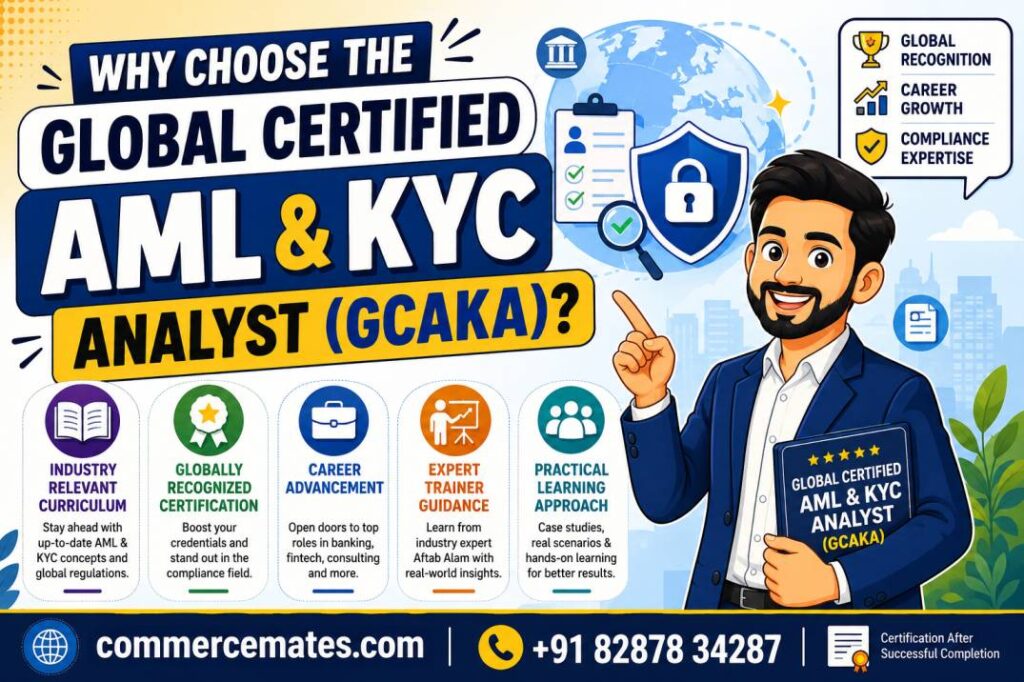
For professionals seeking to build or formalise their KYC expertise, CommerceMates (commercemates.com) offers a structured pathway. Founded by Aftab Alam, an experienced AML/KYC trainer and mentor, CommerceMates is an online learning platform dedicated to bridging the gap between theoretical knowledge and real-world industry expectations.
Its flagship offering, the Global Certified AML & KYC Analyst (GCAKA) programme, is a four-week live instructor-led training designed to take participants from beginner to job-ready professional. The curriculum covers the full spectrum of an analyst’s responsibilities:
- AML & KYC Fundamentals: the money laundering lifecycle, AML regulations, KYC, CDD, and customer onboarding.
- Customer Due Diligence (CDD & EDD): risk-based assessment, PEP handling, and verification of Source of Funds (SOF) and Source of Wealth (SOW).
- Sanctions & Watchlist Screening: hands-on practice with OFAC, UN, EU, and UK sanctions lists, and tools such as World-Check and LexisNexis.
- Transaction Monitoring & SAR: red flags, alert investigation, case management, and Suspicious Activity Report preparation.
- Real-Life AML/KYC Simulation: case studies and practical exercises that mirror the work of an analyst in a bank or fintech.
Beyond technical content, the GCAKA programme includes interview preparation and career support—ATS-friendly resume review, LinkedIn optimisation, mock interviews, and technical interview questions—reflecting its explicit focus on employability. The programme is delivered live over four weeks, with 1.5-hour interactive sessions, and is priced at INR 10,000. Testimonials from participants who have secured roles at institutions such as BNY, Crédit Agricole, and Genpact highlight the practical, confidence-building nature of the training.
CommerceMates also offers one-on-one career coaching for those who want targeted support with resume review, mock interviews, and personalised guidance. With a community of over 12,000 LinkedIn followers and more than 1,000 professionals trained, the platform has established itself as a trusted resource for aspiring and transitioning compliance professionals.
For organisations and individuals serious about KYC training in 2026, the message is clear: theoretical knowledge alone is insufficient. The most effective training is practical, continuous, role-specific, and demonstrably effective. To explore a programme built around those principles, visit c learn more about the GCAKA programme and the career support it provides.