Master the essential skills and knowledge needed to succeed in your KYC Analyst interview with this comprehensive self-assessment.
Contents
Introduction: The Path to KYC Success
Landing a role as a KYC (Know Your Customer) Analyst is a significant step in a rewarding career within financial crime compliance. The interview process can be challenging, testing not only your technical knowledge but also your analytical thinking and understanding of regulatory frameworks.
This free assessment is designed to help you evaluate your readiness, identify key areas for improvement, and build the confidence you need to impress hiring managers. At CommerceMates, we are dedicated to empowering the next generation of AML & KYC professionals, and this guide is a part of that commitment.
What Does a KYC Analyst Do?
Before diving into the assessment, it’s crucial to understand the core responsibilities. A KYC Analyst is the first line of defense against financial crime. Your primary role involves:
- Customer Due Diligence (CDD): Verifying the identity of new and existing customers.
- Enhanced Due Diligence (EDD): Applying more rigorous checks for high-risk customers.
- Risk Assessment: Evaluating customer profiles to determine their money laundering or terrorist financing risk level.
- Sanctions Screening: Checking customer names against global sanctions lists.
- Transaction Monitoring: Reviewing customer transactions for suspicious activity.
- Reporting: Filing Suspicious Activity Reports (SARs) or Suspicious Transaction Reports (STRs) when necessary.
The KYC Analyst Interview Assessment
This assessment is split into three key sections: Technical Knowledge, Practical Application, and Behavioral & Situational Questions. Use this to gauge your current level and focus your preparation.
Section 1: Technical Knowledge Check
Answer these questions to test your understanding of core concepts.
- What is the fundamental difference between Customer Due Diligence (CDD) and Enhanced Due Diligence (EDD)?
- Your Answer:
- Model Answer: CDD is the standard process of identifying and verifying a customer’s identity and assessing their risk profile. EDD is a more in-depth investigation required for higher-risk customers (e.g., PEPs, those from high-risk jurisdictions) to understand their source of funds and wealth in greater detail.
- Name three key documents used to verify a customer’s identity and address.
- Your Answer:
- Model Answer: A valid passport, a government-issued ID card, and a recent utility bill or bank statement.
- What is a PEP (Politically Exposed Person), and why are they considered higher risk?
- Your Answer:
- Model Answer: A PEP is an individual entrusted with a prominent public function. They are considered higher risk due to the potential for corruption, bribery, and money laundering associated with their position and influence.
- What is the purpose of sanctions screening?
- Your Answer:
- Model Answer: Sanctions screening is the process of checking customer names and transactions against government-issued sanctions lists to ensure the institution is not doing business with individuals, entities, or countries subject to financial or trade restrictions.
- What is a Suspicious Activity Report (SAR) / Suspicious Transaction Report (STR), and when would you file one?
- Your Answer:
- Model Answer: A SAR/STR is a confidential report filed with the Financial Intelligence Unit (FIU) when a financial institution suspects that a transaction or activity may be related to money laundering, terrorist financing, or other financial crimes, even if the exact details are unknown.
Section 2: Practical Application Scenario
Read the scenario and explain your approach.
Scenario: You are reviewing a new account application for a company that imports electronics. The beneficial owner is a foreign national from a high-risk jurisdiction. The company’s expected annual turnover is significant, but the source of initial funds is a personal loan from a friend, also a foreign national. The company’s physical office is a co-working space.
Your Approach:
- Identify the Risk Factors: List the high-risk indicators in this scenario.
- Due Diligence Plan: Outline the specific steps you would take to conduct a thorough CDD/EDD review.
Model Approach:
- Risk Factors: The beneficial owner being from a high-risk jurisdiction, the source of funds being a personal loan from an unverified third party, and the company operating from a co-working space (which can be a red flag for shell companies) are all key risk factors.
- Due Diligence Plan:
- Conduct standard CDD: Verify the identity of the beneficial owner and company directors.
- EDD: Obtain more information on the beneficial owner, including their source of wealth (not just source of funds for this transaction).
- Source of Funds: Request a formal loan agreement and bank statements to verify the friend’s identity and the legitimate source of their funds.
- Business Verification: Request copies of business licenses, tax registrations, and potentially vendor or client contracts to verify the company’s legitimate operations.
- Sanctions & Adverse Media: Run a comprehensive sanctions check on all parties and search for adverse media related to the company or its owners.
Section 3: Behavioral & Situational Questions
Prepare answers using the STAR method (Situation, Task, Action, Result) for questions like these.
- “Describe a time you had to handle a high-pressure situation or a difficult customer.”
- “How do you stay updated on changing AML/KYC regulations?”
- “Give an example of a time you identified a potential red flag. What did you do?”
- “Why are you interested in a career as a KYC Analyst?”
Next Steps: How to Prepare for Your Interview
- Review the Fundamentals: Solidify your knowledge of CDD, EDD, PEPs, sanctions, and SAR/STR reporting.
- Practice Scenarios: Think through real-world examples like the one provided above to sharpen your analytical skills.
- Structure Your Answers: Practice using the STAR method for behavioral questions to provide clear, concise, and impactful responses.
- Stay Current: Follow regulatory updates from bodies like the FATF and local financial intelligence units.
Ready to Take Your Career to the Next Level?
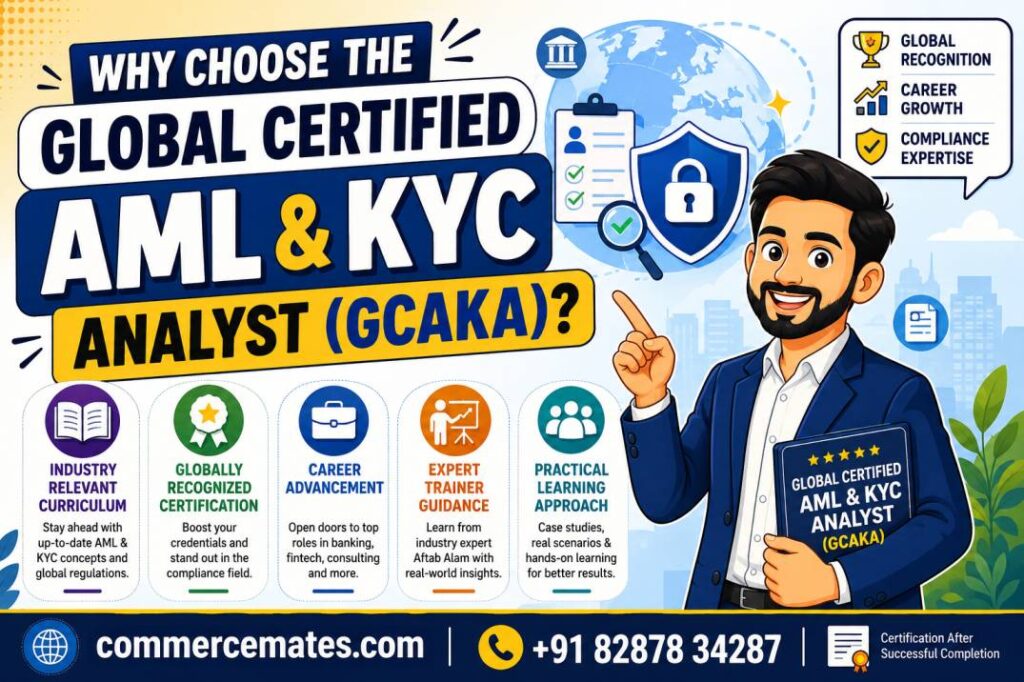
Acing an interview requires not just assessment but structured, in-depth preparation. At CommerceMates, we offer a comprehensive 4-Week Global Certified AML & KYC Analyst (GCAKA) Training Program designed to transform you from a candidate into a highly confident, job-ready professional.
Our program provides:
- Live Instructor-Led Classes with real-world case studies.
- Interview Preparation including resume and LinkedIn optimization.
- Lifetime Learning Support and access to a professional community.
With over 1,000+ professionals trained and a thriving community, we are your partner in building a successful KYC career.
Conclusion
Use this assessment as a starting point for your interview preparation. Identify your strengths and the areas where you need to dig deeper. Remember, confidence comes from knowledge and practice.
Good luck with your interview! You are on the right path.