The financial crime compliance industry is at a critical juncture. As money laundering and terrorist financing techniques grow more sophisticated, regulatory scrutiny has intensified. Yet, many training programs remain stuck in the past, focusing on rote memorization of regulations rather than the practical application of skills. The result is a persistent talent gap: employers are seeking analysts who can think on their feet, while many qualified candidates possess certificates but lack the job-ready competence to perform.
This disconnect is why I designed the Global Certified AML & KYC Analyst (GCAKA) program differently. It is built on a fundamental belief: a certificate should be a tool for building a career, not just a line on a CV.
Here is how my approach in the GCAKA program stands apart.
Contents
1. From Passive Theory to Active Practice
Many AML/KYC courses are built on a foundation of theoretical knowledge. They teach you the definitions of Customer Due Diligence (CDD) and Enhanced Due Diligence (EDD), but they stop there. In the GCAKA program, I believe that understanding the “what” is just the beginning.
My teaching approach is intensely practical. Every concept is immediately applied to real-world scenarios. You won’t just learn about transaction monitoring; you will work through simulated alerts, identify red flags, and determine the appropriate course of action. You won’t just memorize sanctions lists; you will practice screening customers against global watchlists like those from OFAC, the UN, and the EU. This hands-on method ensures you understand not just what to do, but why these processes are essential in preventing financial crime.
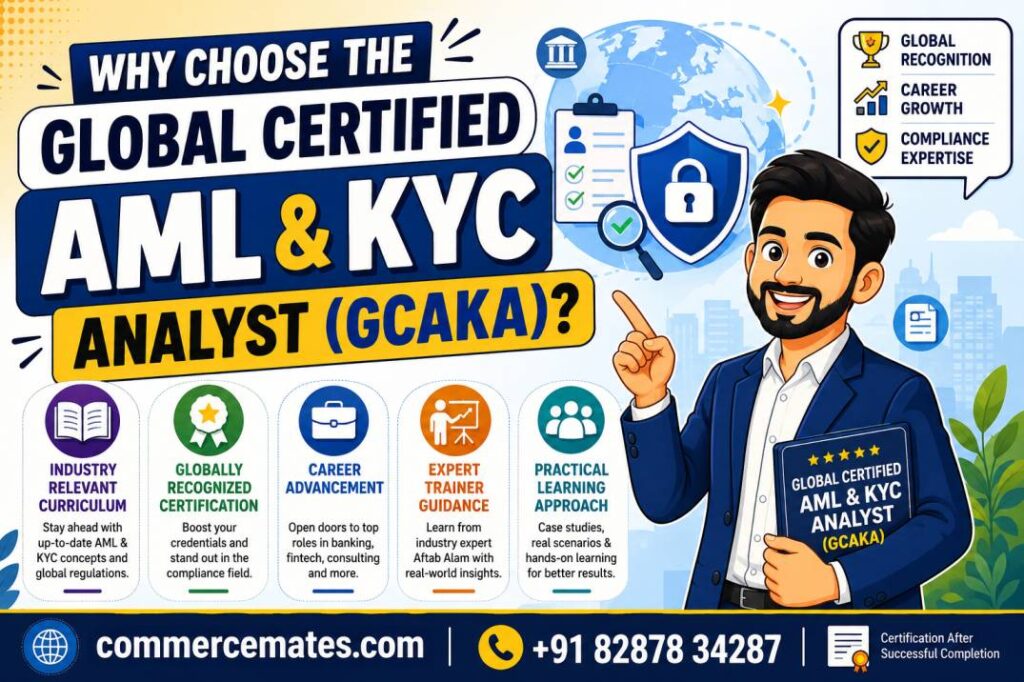
2. A Curriculum Built for the Job, Not the Exam
The goal of the GCAKA program is not to pass a test—it is to get you hired and effective from day one. The curriculum is structured to bridge the gap between theoretical knowledge and practical application.
Over four intensive weeks, we cover the complete spectrum of an AML/KYC analyst’s responsibilities. We move beyond the fundamentals of money laundering to dissect complex, modern typologies. We dive deep into the Risk-Based Approach, the intricacies of identifying Ultimate Beneficial Owners (UBOs), and the challenges posed by Politically Exposed Persons (PEPs). This focus on practical, job-ready skills means you are learning what employers actually need, not just what a textbook says.
3. Learning from Real-World Case Studies, Not Just Hypotheticals
The most effective learning happens when you are confronted with the messy, high-pressure, and ambiguous situations that define a real analyst’s workday. This is why the GCAKA program is built around real-world case studies and simulations.
Instead of abstract examples, we analyze actual financial crime scenarios. We examine how seemingly benign customer behavior can be a red flag, how to investigate alerts using transaction monitoring tools, and how to prepare a Suspicious Activity Report (SAR/STR) that meets regulatory standards. This case-study-driven approach sharpens your analytical judgement and prepares you to make informed decisions under uncertainty—a skill that is impossible to develop through theory alone.
4. Live, Instructor-Led Mentorship
In an era of self-paced, online courses, the value of live human interaction cannot be overstated. The GCAKA program is delivered through live, instructor-led weekend training sessions, creating a dynamic learning environment.
This format allows for real-time discussions, immediate Q&A, and the opportunity to learn from the experiences of your peers. As your instructor, I bring years of practical experience in AML, KYC, and financial crime compliance directly to the virtual classroom. My role is not just to deliver content, but to act as a mentor, guiding you through complex topics and providing insights that only come from real-world practice.
5. Career Support That Goes Beyond the Classroom
A certification’s value is ultimately measured by its impact on your career. I recognized early on that teaching the skills is only half the battle. The other half is helping you effectively communicate those skills to potential employers.
This is why the GCAKA program includes a comprehensive career support component that is integrated into the training:
- ATS-Friendly Resume Review: We work together to refine your resume so it passes automated applicant tracking systems and highlights your new practical skills.
- LinkedIn Optimization: Your profile is your professional brand. We optimize it to attract recruiters.
- Mock Interviews: You will practice HR and technical interviews, receiving direct feedback to build your confidence.
- 100% Interview Assistance: This unique feature ensures that you are not just trained but are actively supported in your job search, with guidance on targeting the right roles and progressing through the hiring process.
Conclusion: Building Competence, Not Just Credentials
The AML/KYC field is evolving rapidly, and the industry needs professionals who can do more than just pass an exam. It needs analysts with critical thinking skills, practical experience, and the confidence to apply their knowledge in real-world situations.
The Global Certified AML & KYC Analyst program is my answer to that need. It is a focused, practical, and career-oriented program designed to transform motivated individuals into competent, job-ready professionals. It is about building genuine capability, because in the fight against financial crime, competence is the only credential that truly matters.
If you are ready to move beyond theory and build a real, practical skill set for a career in financial crime prevention, I invite you to explore the GCAKA program.