India’s financial sector is experiencing unprecedented growth, and with it comes an escalating need for robust Anti-Money Laundering (AML) and Know Your Customer (KYC) frameworks. As the government tightens regulations to combat financial crime, the demand for skilled AML and KYC professionals in Indian corporates is surging. This article serves as a comprehensive guide for anyone in India looking to start or advance a career in this dynamic and meaning
ful field.
Contents
Why AML & KYC is a High-Demand Career in India
The importance of AML and KYC has never been more critical. Financial crime is becoming increasingly sophisticated, forcing banks, fintech companies, payment processors, and other financial institutions to invest heavily in compliance. A recent survey revealed that 75% of Indian organizations plan to expand their AML/KYC teams in the coming year, making it one of the hottest career paths in the country.
This demand translates into competitive compensation, with experienced professionals earning between ₹15 lakhs to ₹50 lakhs annually. For freshers, the field offers a career with purpose, global recognition, and long-term stability. Moreover, skills in AML and KYC are transferable globally, opening doors to opportunities in financial hubs like the UK, UAE, US, and Singapore.
AML Training and Certification in India
To enter this field, specialized training and certification are crucial. While options exist globally, India offers several excellent pathways to build the necessary expertise.
1. The Global Certified AML & KYC Analyst (GCAKA) Program
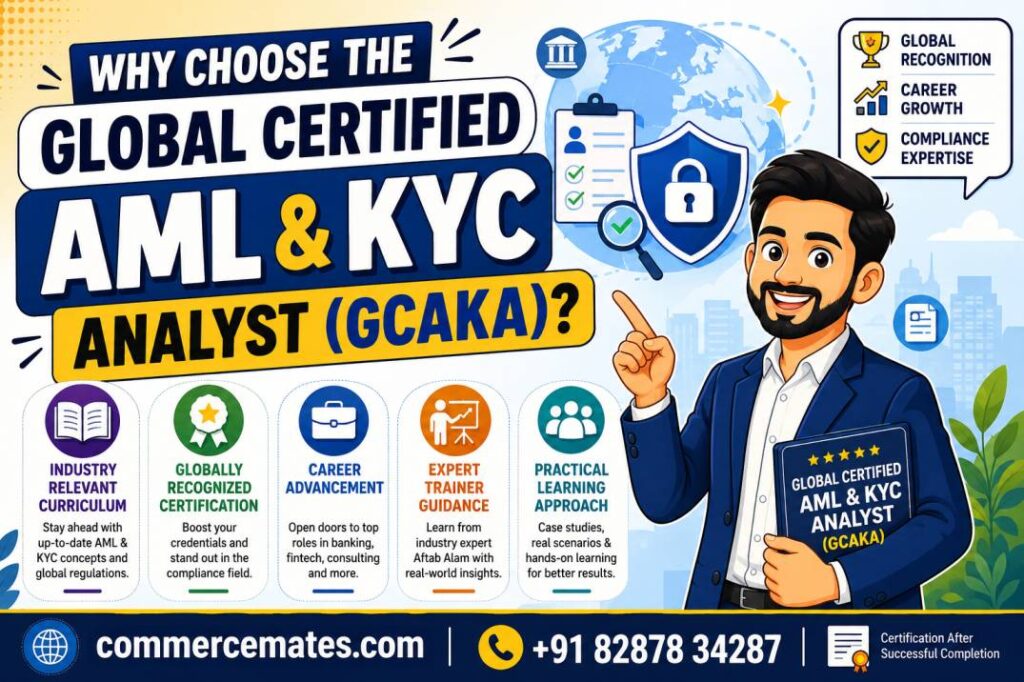
For individuals seeking a focused, practical, and globally relevant certification, the Global Certified AML & KYC Analyst (GCAKA) program offered by CommerceMates stands out. This program is specifically designed to build practical AML and KYC expertise through real-world case studies, preparing candidates for immediate roles in the industry.
The curriculum covers all essential areas, including:
- Customer Due Diligence (CDD) and Enhanced Due Diligence (EDD)
- Transaction Monitoring and Sanctions Screening
- AML Investigations and Suspicious Activity Reporting (SAR/STR)
- Understanding Politically Exposed Persons (PEPs) and Ultimate Beneficial Ownership (UBO).
The GCAKA program’s value lies in its industry-focused approach. It combines live instructor-led classes with career preparation support, such as resume building and interview guidance, to ensure candidates are job-ready.
2. Aftab Alam: A Key Figure in Indian AML Training
A key figure in this space is Aftab Alam, a consultant and trainer who is instrumental in empowering the next generation of AML professionals in India. Through CommerceMates, Aftab Alam provides personalized one-on-one career coaching, including resume reviews and mock AML/KYC interviews, to help candidates confidently secure their roles. This personalized mentorship is a significant asset, bridging the gap between theoretical knowledge and practical job placement.
3. Other Notable Indian AML Programs
- NSE Academy & ACAMS Collaboration: To strengthen AML education in India, NSE Academy has partnered with the Association of Certified Anti-Money Laundering Specialists (ACAMS) to offer a range of certification courses, including the globally recognized Certified Anti-Money Laundering Specialist (CAMS) certification. This partnership provides access to a premier network of peers and thought leadership in the industry.
- ICAI Certificate Course: The Institute of Chartered Accountants of India (ICAI) offers a comprehensive certificate course on Anti-Money Laundering Laws, providing deep dives into the legislative and regulatory frameworks in India.
- Specialized Government Initiatives: The International Financial Services Centres Authority (IFSCA) has launched its own mandatory certification course, NISM-IFSCA-01, focused on AML and Counter-Terrorist Financing (CTF) within the IFSC ecosystem.
What You Will Learn in a Quality AML Training Program
A good AML training program, like the GCAKA, will cover a range of practical and regulatory topics necessary to succeed. You can expect to learn about the three stages of money laundering (placement, layering, and integration) and the frameworks designed to combat it, such as the FATF recommendations and India’s Prevention of Money Laundering Act (PMLA).
Core skills taught include creating customer risk profiles, performing due diligence on high-risk clients, researching negative news using various databases, and analyzing suspicious transactions. These are exactly the skills that organizations like Interactive Brokers and MUFG look for when hiring for roles like EDD Analyst or KYC AML Screening Analyst.
Career Pathways and Opportunities
Completing a recognized certification like the GCAKA opens doors to numerous entry-level and mid-level roles across the financial spectrum. Graduates can pursue careers as:
- AML Analyst
- KYC Analyst
- CDD/EDD Analyst
- Transaction Monitoring Analyst
- Compliance Analyst
- Financial Crime Analyst
These roles are available in global banks, fintech companies, payment processors like Aditya Birla Housing Finance, and multinational financial institutions. Companies often prefer candidates with certifications like CAMS or similar, making the GCAKA a valuable asset on your resume.
Conclusion: Start Your AML Career Today
For freshers and professionals in India, a career in AML and KYC offers a unique combination of growth, stability, and the opportunity to make a meaningful impact by protecting the financial system. With the right training, such as the Global Certified AML & KYC Analyst (GCAKA) program, and guidance from experts like Aftab Alam, you can gain the practical skills and confidence to excel in this high-demand field. The time to invest in a career that offers global opportunities and professional growth is now.